

You're Not Special
Meditations on mundanity, living abroad, and William Stoner
I feel like I was the last person to read John Williams’ 1965 novel Stoner, but I know it was for good reason. It spans the life of William Stoner, an academic who falls in love with literature after reading a Shakespearean sonnet in an English 101 class. He abandons his agriculture degree – which would have led to a solid, predictable life on his family’s farm – and pursues his love for literature. Still, he remains an average man. He makes mistakes, spends his whole life working in the same job in the same place, marries the wrong woman, and tries and fails to become a writer. But still, despite all of this mundanity, he manages to find passion, love, and beauty in a life that ended largely (though not entirely) unfulfilled. As he lies, dying, at the end of the book, the narrator writes:
Beneath the numbness, the indifference, the removal, it was there, intense and steady; it had always been there. In his youth he had given it freely, without thought; he had given it to the knowledge that had been revealed to him…He had, in odd ways, given it to every moment of his life, and had perhaps given it most fully when he was unaware of his giving. It was a passion neither of the mind nor of the flesh; rather, it was a force that comprehended them both, as if they were but the matter of life, its specific substance. To a woman or to a poem, it said simply: Look! I am alive.
I wonder why this book has had such a resurrection now, half a century later. It was borderline unknown for decades after publication. The past five years or so have seen a new generation of readers discover and adore it, and if I look through a personal lens, its revival makes complete sense. To endure a world burdened by constant greed-induced calamity, we naturally become apathetic and numb. The past year of my life has been full of whiplash and constant uncertainty – much of which has to do with the state of the world, but some of it is just a result of being 25 and confused. Because of this, I’ve settled into simplicity. I don’t want to hustle or resist. I’m tired. I want to have the same thing for lunch every day. I want to live in the same place for years and years. I want to work a steady job. I do not enjoy social media, mainly because the constant churning of the trend cycle sucks me out of my body and turns me into a shell of a woman.
People laugh when I tell them I’m really bad with change. I moved my entire life overseas; is that not succumbing to a life always threatened by change? Yes, and even more so than I had expected. And I can’t help but feel a little spiteful at my younger self, who made things incredibly difficult for me by making that choice. I moved abroad at 19, and decided very early in life that I wanted to be a writer. These are two things I resent myself for now, though I don’t regret them. As I lose sleep over my visa status, mourn a family loss I can’t be home for, and humiliate myself trying to build a platform on TikTok because it might help me get published, I repeat the mantra that keeps me going: I chose this! I chose this! I chose this!
But why did I choose this? My scripted answer, when anyone asked, was that I felt some kind of calling. “Things are calling me away. My hair is being pulled by the stars again”, wrote Anaïs Nin, a quote I wrote repeatedly in my journal when I was sixteen. It seemed obvious. I remember sitting in a parking lot with my dad in my senior year of high school. Where are you going? He asked me. What are you running from? Six years later, I can consider it with a new, more experienced mind. I think – I know, deep down – I just wanted to be remarkable.
“What the Living Do” by Marie Howe:
Johnny, the kitchen sink has been clogged for days, some utensil probably fell down there.
And the Drano won’t work but smells dangerous, and the crusty dishes have piled upwaiting for the plumber I still haven’t called. This is the everyday we spoke of.
It’s winter again: the sky’s a deep, headstrong blue, and the sunlight pours throughthe open living-room windows because the heat’s on too high in here and I can’t turn it off.
For weeks now, driving, or dropping a bag of groceries in the street, the bag breaking,I’ve been thinking: This is what the living do. And yesterday, hurrying along those
wobbly bricks in the Cambridge sidewalk, spilling my coffee down my wrist and sleeve,I thought it again, and again later, when buying a hairbrush: This is it.
Parking. Slamming the car door shut in the cold. What you called that yearning.What you finally gave up. We want the spring to come and the winter to pass. We want
whoever to call or not call, a letter, a kiss—we want more and more and then more of it.But there are moments, walking, when I catch a glimpse of myself in the window glass,
say, the window of the corner video store, and I’m gripped by a cherishing so deepfor my own blowing hair, chapped face, and unbuttoned coat that I’m speechless:
I am living. I remember you.
The truth is, most of us will live unremarkable lives. Out of eight billion people in the world, only a handful will receive public praise and attention. But this is all that we see. The digital world is a vacuum of accomplishments and subtle flaunting. It’s at the core of our days, what we return to when we’re stuck in traffic on the bus or sat on the toilet, impact radiating beyond the pixels and into every corner of reality. And until you can announce something that makes you feel – even for a sliver of digital time –special, you will always feel left behind.
Years before I moved to London, I daydreamed about the way I would announce it. I drafted Instagram captions in my notes app, I wrote scripts in my head for telling my best friend and my favorite teacher, and at one point, I even pretended to be a 19-year-old living in London while speaking to a stranger online, just so I could know how it felt to say it.
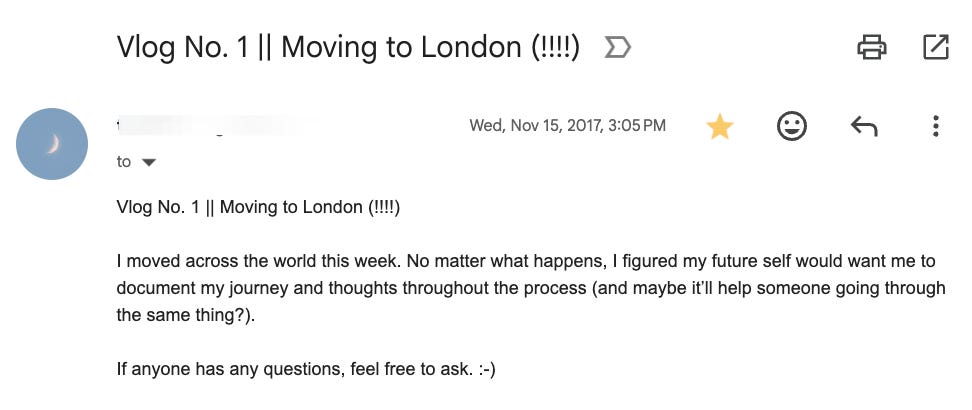
When it happened, the moment was fleeting. I basked in the light of my uniqueness until I had to say goodbye to my Dad as he got on the Piccadilly line after we spent three days moving me into my student housing. I went into the Waitrose outside the station and bought oat milk and cried. The first six months were really difficult. I had half of a friend. I thought about giving up and going home. But I posted photos of cafés and bookstores and that lovely London architecture, and everyone thought otherwise. I had a falling out with a friend who told me she couldn’t bear to see me live a life she wanted.
Then, it all ended. A week before everything shut down, my mother booked me a flight home because she was worried about me. I was deeply depressed. I didn’t go to class, barely left my bed, and ate Nutella and Ritz crackers for my meals. I felt like I had failed. The year and a half I spent back in my hometown was like a life in itself. I worked at my old café job. I drove my old car and slept in my old bed. At the time, I didn’t know if I’d be going back. The thing that made me special was no longer there. Who was I without it?
I found out eventually. Things began to reveal themselves among the stillness. I started writing again. I started reading again. I downloaded Animal Crossing: New Horizons. I made new friends and got closer to old ones. This was monumental. I was a formerly gifted child of immigrant parents, and I needed accomplishments to build a personality. But I accepted that my life – no matter where I was in the world – was composed of individual, seemingly mundane moments, most of which I would be the only one to see. Forever is composed of Nows, writes Emily Dickinson. ‘Tis not a different time – / Except for Infiniteness –/ And Latitude of Home.
In eighth grade, just before graduation, our English teacher showed us a video titled: "You Are Not Special”. We all found this very offensive. The speech was a Wellesley High School commencement speech by David McCullough Jr. given in 2012. I don’t remember much from middle school, but this memory is vivid. Everyone in that class I speak to remembers it too. The conversation goes something like, remember when Mrs. Huse told us we aren’t special? Yeah, thank god she did.
Some excerpts:
In our unspoken but not so subtle Darwinian competition with one another – which springs, I think, from our fear of our own insignificance, a subset of our dread of mortality — we have of late, we Americans, to our detriment, come to love accolades more than genuine achievement. We have come to see them as the point — and we’re happy to compromise standards, or ignore reality, if we suspect that’s the quickest way, or only way, to have something to put on the mantelpiece, something to pose with, crow about, something with which to leverage ourselves into a better spot on the social totem pole.
Like accolades ought to be, the fulfilled life is a consequence, a gratifying byproduct…you too will discover the great and curious truth of the human experience is that selflessness is the best thing you can do for yourself. The sweetest joys of life, then, come only with the recognition that you’re not special. Because everyone is.
Today, more Americans are moving to London than ever. I hear them on the streets. I meet them at parties. Many of them are my close friends. I cannot imagine my life here without them. I am not that proud of having moved here. The hard part is what comes after. The familiarity, the friendship. Tending a seed until it bears fruit. My life has been built on tiny, silent moments of bravery – a yes to a new friend, to a coffee date, to a job offer or an invitation. That’s what I’m proud of. It’s not an accomplishment in the traditional sense of the word, and I can’t post it on my Instagram or announce it on LinkedIn. But those are short-lived. This is the kind of thing I’m reminded of every day.
I finished writing my novel in October. I was relieved, at first. It was like the world had opened up again. I could see my friends, read my book on lunch breaks, sleep in and go to bed early. Eventually, I discovered that my life was actually closing in on itself. I was, and am, inundated with insecurity. Novelists have always existed (though they haven’t always posted their Publishers Marketplace screenshots on Instagram), and yet it was after I finished writing that I really started to compare myself. Is this any good, even? Did I waste two and a half years of my life to make something no one will ever get to read? I imagine this is why some writers start a new project immediately after finishing one, to seal off their minds so that the smoke can’t get in.
It’s not easy. I know I have a long road ahead of me. But what they say is true – it should always be about the process. When I eventually get to post my Publishers Marketplace screenshot, it’ll live on people’s feeds for a few days before disappearing into the digital void. When my book is wrapped in cloth and paper and put into the warm hands of a reader, the smell of newly printed pages will wear off. After it’s been read, it’ll live on someone’s bookshelf until its edges are dusty. Eventually, it’ll be donated to Goodwill. But the hours I spent immersed in this little world, made up of 107,000 words I crafted inside my head, will always remain a part of me. If every one of those words were an hour, it would build the life of a 12-year-old child. We are all made of minutes and words. These are things no one will get to see. That’s okay.
From Stoner:
A kind of joy came upon him, as if borne in on a summer breeze. He dimly recalled that he had been thinking of failure–as if it mattered. It seemed to him now that such thoughts were mean, unworthy of what his life had been. Dim presences gathered at the edge of his consciousness; he could not see them, but he knew that they were there, gathering their forces toward a kind of palpability he could not see or hear. He was approaching them, he knew; but there was no need to hurry. He could ignore them if he wished; he had all the time there was.

There was a softness around him, and a languor crept upon his limbs. A sense of his own identity came upon him with a sudden force, and he felt the power of it. He was himself, and he knew what he had been.
2025 was a noisy year for me. It felt like the end of something, like I was leaving behind a version of myself and starting entirely from scratch. It’s January, and I kind of feel like a newborn baby. Extra sensitive. Crying a lot. But I have a good feeling. If this year is quiet, it’ll be a relief. After all, if last year was the end – well, this must be a beginning.
Hope you’re all well. Take care.
<3 T
I wrote a long comment last night and it deleted when i tried to post💔 I really really needed to read this - as someone living abroad and only seeing writing as a viable future. i wish the desire to be seen an acknowledged wasn’t so ingrained in me
"If every one of those words were an hour, it would build the life of a 12-year-old child." :') beautiful and special (because everything is)