

Far From Home
London, Iran, and the Moon
I found out about the launch of Artemis II 24 hours after everybody else did. My boyfriend told me as I was brushing my teeth. I had spent nearly 12 hours in the office and barely looked at my phone, though I don’t spend as much time online anymore anyway. It made me feel so untethered to everything, so isolated. Why didn’t people shout it from the rooftops? Why weren’t people dancing in the street? Why didn’t I get a newspaper at my door that morning with the headline EXTRA! EXTRA! WE’RE GOING TO THE MOON!? Every day, there are war crimes, tragedies, people being horrible to each other. Somewhere amongst it all, four people are deep in space, greeting the moon.
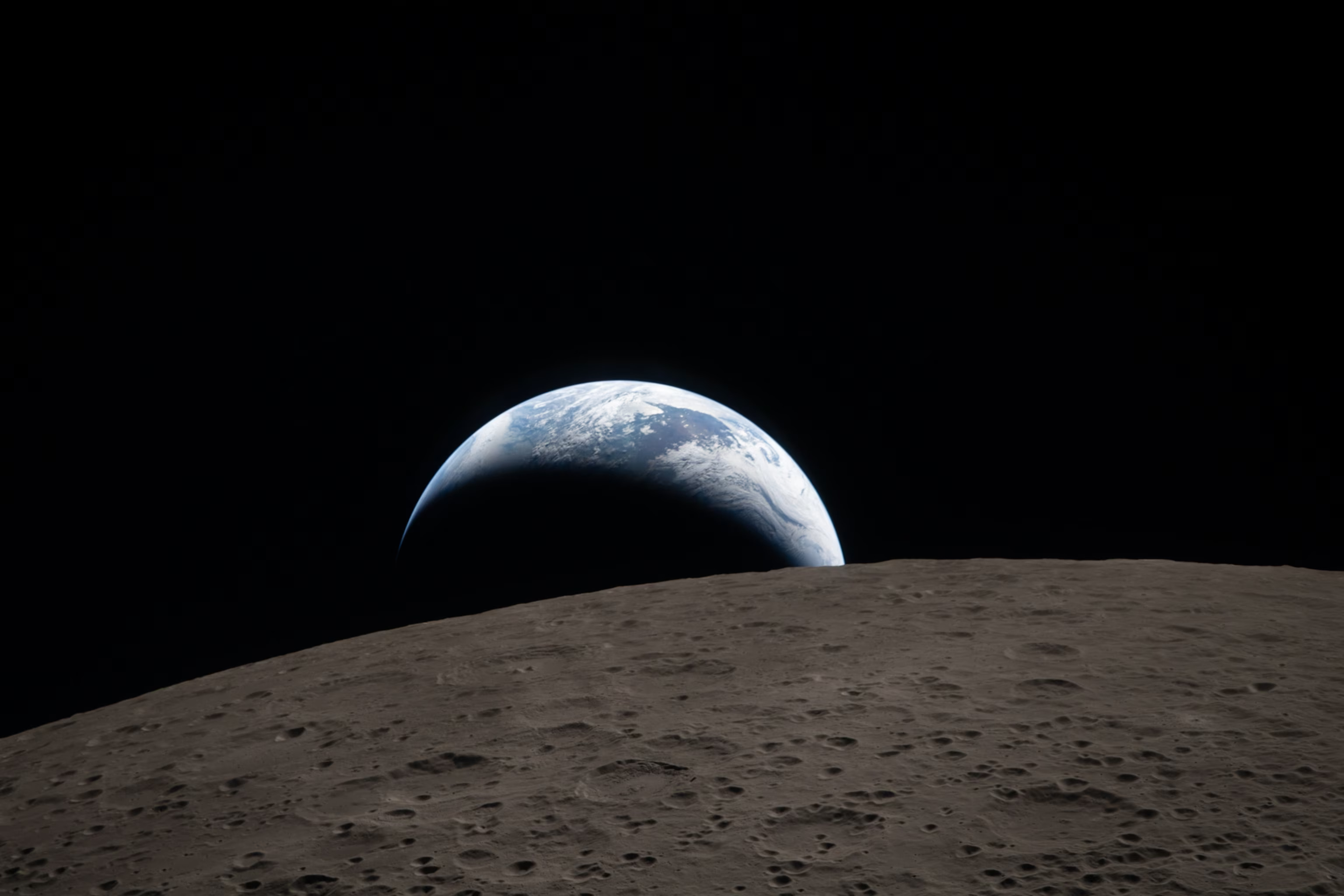
The farthest point that these four astronauts have travelled is 250,000 miles from Earth. It’s the farthest any human has been. Human is the keyword. There’s a photo of Christina Koch’s braids floating as she looks down at the blue and white swirls of Earth, which she inevitably did with nimble fingers, in the same way billions of women have done and are doing. The crew proposed a name for a fresh lunar crater: Carroll, the late wife of mission Commander Reid Wiseman, who passed in 2020. If you watch the raw video of Jeremy Hansen proposing the name to NASA, voices wobble, tears bead in the air away from their eyes, and they all float toward each other in a group hug. Humanity, love, joy – all being felt in places it has never been felt before. Before Artemis II went out of radio communication for 40 minutes, Victor Glover said: “As we prepare to go out of radio communication, we are still going to feel your love, from Earth…we love you, from the moon.”
“Lament” by Rainer Maria Rilke:
Everything is far
and long gone by.
I think that the star
glittering above me
has been dead for a million years.
I think there were tears
in the car I heard pass
and something terrible was said.
A clock has stopped striking in the house
across the road…
When did it start?…
I would like to step out of my heart
and go walking beneath the enormous sky.
I would like to pray.
And surely of all the stars that perished
long ago,
one still exists.
I think that I know
which one it is –
which one, at the end of its beam in the sky,
stands like a white city...
I live 3,800 miles from my family, a distance which doesn’t seem too far, all things considered. But there are times when London feels like the moon. When the US declared war on Iran, there was nothing more I wanted than to be at home with my family. That life feels so far away, now. The memories I have there, even mere weeks after they take place, feel like they don’t belong to me. Sometimes, if I think hard, I can go there – I can see the colors of the Persian rugs, smell the wood floors, the Dial hand soap in our downstairs bathroom. But they all feel distinctly separate, of an entirely different world. I think that’s just the nature of memory. I mourn it, anyway.
My parents left Iran, like most, in 1979. They were teenagers and had yet to meet. My mom came with her family, and my dad was alone. They both still speak about Iran so vibrantly. My dad can remember the smell of manure in his mountain town. My mom remembers the way light shone through the courtyard of her grandmother’s house. These are memories they’ll never get back. Still, they keep them alive, passing them between friends and family members, like a ball they can’t let fall to the ground.
The beautiful thing about the Iranian diaspora is that it’s spread all over. I forget that, sometimes, when I miss the sound of my mother tongue. I hear it out in the streets a lot, but I rarely engage. It just makes me feel homesick, sometimes guilty. I spent most of my life in the presence of family members who spoke my language the way I spoke it, who understood the cultural nuances of our religious minority. I have experienced so little reckoning with my heritage beyond my immediate circle. The war pushed me to look outside myself, outside my familial circle, and to recognise what I’m a part of. I’ve never been to Iran. I don’t inherit my parents’ memories, but I inherit the longing. I long for somewhere I’ve never been; I miss a country that only exists in my blood. But maybe that’s enough.
In early March, a week after the war began, my boyfriend and I went to see an Iranian indie-funk band called Parviz at a tiny basement venue close to my house. A friend had told me about it, but I didn’t get tickets until the last minute. It wasn’t traditional Persian music, but there were pieces of Iran rippling throughout the performance – a synth beat reminiscent of the pre-revolution music scene, a shirt with JOON embroidered on it, titles like Azadeh (freedom) and T’am-e gilas (Taste of Cherry, a film by Abbas Kiarostami). When the artist spoke about the war, the whole room erupted into cheers of solidarity. I grew up in a cultural bubble, and it was in this moment that – maybe for the first time – I saw myself beyond it. To be Iranian in the modern world sometimes means living in the past, immersed in the stories of what Iran used to be, told by people who wouldn’t recognise it upon their return. But there is so much more.
“To See It” By Laura Foley:
We need to separate
to see the life we’ve made,
to leave our house
where someone waits, patiently,
warm beneath the sheets,
to don layers of armor,
sweater, coat, mittens, scarf,
to stride down the frozen road,
to put distance between us
this cold winter morning,
to look back and see
on the hilltop, our life,
lit from inside.
When I first moved to London, the men who ran the off-license by my student accommodation were Afghan. I would go to grab some gum or a room-temperature soft drink just so I could hear my language on someone else’s tongue, someone who wasn’t a friend of a friend of a distant family member. Everything was so new. It was the first time I was living away from home. The morning after we saw Parviz, we went to a new Iraqi-Iranian café that opened in my neighborhood. The queue went halfway down the road. When we got in, I spoke to one of the owners as he was making my order in the open kitchen. Upon discovering I was Iranian, his voice changed to something warm and familiar, and as I left, he called me azizam and told me to take care of myself. Mere days after, my UK Visa was renewed. I was able to book a flight home to celebrate Nowruz with my family, and I cried with relief.
I’m far from home in more ways than one. At the same time, I am building my own, just as my parents, aunts, and uncles did when they moved to America. The world – and beyond it – is bigger than I ever could have imagined. Every day it expands. I see something new on the internet: a photo of a person I have never seen before, a product I “need” to buy, an opinion I don’t share from a place very far away. But there are always familiar things. Sometimes they are right in front of you. Other times, they’re as far away as the moon.
This has been sitting in my drafts for a month, and I just felt it buzzing in there, desperate to get out. It’s a short one, but hopefully still something.
I’m leaning into a quiet year in 2026 – I’m not on Substack much, but I’m not on anything much. I spend a lot of time contemplating, often quietly or echoing off of my loved ones. So I apologise for the sparse publishing – but as Lena Dunham said in the pilot of Girls, I am busy trying to become who I am.
Speak soon, love always.
Xx
Tara
Always a delight to read your pieces no matter how short. And there’s always a line or too and that leave me in awe. This time it’s:
“These are memories they’ll never get back. Still, they keep them alive, passing them between friends and family members, like a ball they can’t let fall to the ground.”
Found this and read it after finding out Marjane Satrapi passed. I am not Iranian, but with this current war, I’m trying to understand the Iranian perspective and life a little more. This is a wonderful piece and left me wanting to read more. Wishing you the best!